
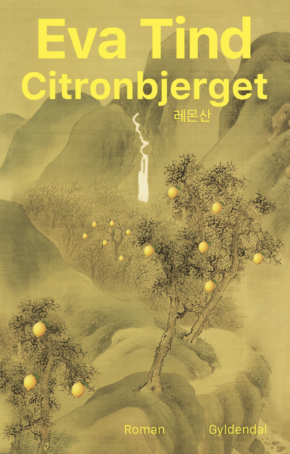
Two days ago, I closed the door to my three-room apartment in Copenhagen. Now, I stand in a little tree palace, enveloped by the beauty of the mountain. Still, I cannot quite fathom it. Does this paradise really belong to me?
After twenty-five years of marriage, Sui decides to divorce her husband. She can’t really pinpoint why, can’t say what’s actually wrong – only that something is. She yearns to be free, free to do something else, anything else, yet no matter what she does, the sense of liberation eludes her. When Sui is in her most disillusioned state, she receives a letter – a letter that changes everything.
Sui’s estranged Korean grandfather, her harabeoji, has passed away, and with him, a fragment of her past has perished too. Sui has never met the man; all she has is a photo of him and an ardent awareness that he was the last remaining bridge to her roots. Now that he is gone, she feels she has lost the ability to understand the final part of who she is.
When Sui learns that her grandfather has left her his property on Lemon Mountain, she decides to travel from the vast and flat landscapes of Denmark to the tall and proud mountain ranges of Korea. She leaves her failed marriage and her adult daughter behind, and she can’t help but wonder: is she making the right choice?
Despite her ties to Korea, the country initially feels foreign to Sui. However, she isn’t far into her journey when she encounters a diverse set of characters, who draw her into their world and offer her a sense of belonging. At first, a family connection is revealed which offers Sui a rare sense of kinship – she has a cousin, Sally, who is born on the very same day as Sui herself. Once on the mountain, a mysterious man appears, sharing a name with the historical figure Sui is writing about. Strangely, he insists that he knows her. And, among the tall tongues of grass, Sui encounters the gardener on Lemon Mountain, who is soon accused of arson and whose daughter disappears into the thick forest of the mountain.
Sui is slowly immersed into the life on Lemon Mountain, and her fascination for the people there spurs a thought – she decides to stay on the mountain for a year. As the leaves change color, the passing of the seasons mirrors her own emotional unraveling and her feeling of being a stranger slowly trickles away. She finds that the freedom she has sought for so long suddenly surrounds her, and at last, she knows that the mountain is where she belongs.
In Lemon Mountain, Eva Tind delicately portrays the complexities of belonging and the endless search for meaning. Through fictional magic we are drawn into a wondrous story of love and longing. Here, we are reminded that the only way to find ourselves is to break free from all we know, and let a new landscape reshape our minds and souls.
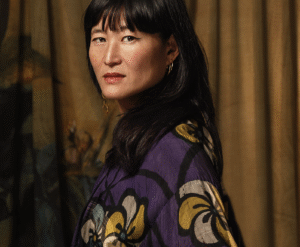
Author
Reviews
“Eva Tind has created a wonderful framework for her story about a body and a mind, that after years of imbalance finally find a harmonious, dozing calm. […] Lemon Mountain is a magnificent novel. You drift easily and weightlessly into the surprising plot on a sensory-saturated and lemon-scented current of air current that stimulates all the senses. […] Not only is it beautifully, beautifully written, but this story of a woman who begins to flourish due to her family’s roots is also an incomparable narrative about the precious interplay between humans, culture, and nature.”
– Jyllands-Posten, 6/6 Stars (DK)
“Eva Tind masters many genres, and in her new book, Lemon Mountain, she demonstrates this with vivid insight into an artist’s creative process and work, while adding a little bit of fictional magic. […] In many ways, Lemon Mountain is also a book about surrender. To grief, to love, to desire, perhaps even to fate. It demands a similar surrender of the reader to this eccentric universe, but it doesn’t require much persuasion when it comes from an author who writes as enchantingly beautifully and sensuously as Eva Tind.”
– Kristeligt Dagblad, 5/6 Stars (DK)
“Lemon Mountain is written with a spherical and exquisite literary technique, filled with strange images in a glow of a dreamy surreality, and it is read with an elevated alertness on the edge of the recognizable.”
– Weekendavisen (DK)
“Eva Tind has written a novel that is especially worth reading for its light touch, a novel almost as unfocused as life itself, yet more colorful, more gleaming.”
– Information (DK)
“Lemon Mountain is written in a lulling and sensuous prose with a well-functioning combination of external and internal actions. […] A beautiful little story about a woman that slowly lifts her foot, preparing to take a step into a new and unexplored chapter of her life.”
– Berlingske, 4/6 Stars (DK)